Aug 12, 2026
How production RAG actually works
Beyond upload-and-chat — parsing, cleaning, metadata, structure-aware chunking, hybrid retrieval, reranking, grounding, and citations. Plus what’s next for Hayat Matrix LIS, agentic AI, and MCP.
Most “RAG demos” hide the hard parts. You upload a PDF, a spinner runs, and a chat box answers with confidence. You never see parsing, cleaning, metadata, chunk strategy, hybrid retrieval, or grounding failures.
Production RAG is a system: prepare knowledge carefully, retrieve it with more than one mechanism, compress what you keep, generate only from evidence, and make every important claim checkable.
We built RAG Observatory so you can watch that system run — upload a document, follow each stage, ask questions, and verify citations. This article explains the ideas behind it: how a production RAG pipeline actually works, stage by stage.
Try the lab: Open RAG Observatory
Conventional RAG vs production RAG
Tutorial RAG is usually a short path:
Upload → split every N tokens → embed → top‑k cosine → stuff into a prompt → hope
That teaches vocabulary, not reliability. Real systems fail for boring reasons:
- Bad OCR or lost layout
- Headers and footers polluting retrieval
- Tables shredded across random windows
- Exact IDs and rare names missing from vector-only search
- Overconfident answers with no evidence
- “Validators” that only echo the first model
Production RAG makes every step visible, testable, and disagreeable — meaning a later stage can land somewhere different when an earlier stage is wrong.
In the Observatory you practice a simple loop: upload something you know, ask an in-doc question, ask an out-of-doc question, open the citations. If a claim isn’t in a cited snippet, that is a grounding failure — not a vibe check.
The full architecture
End to end, production RAG looks like this:
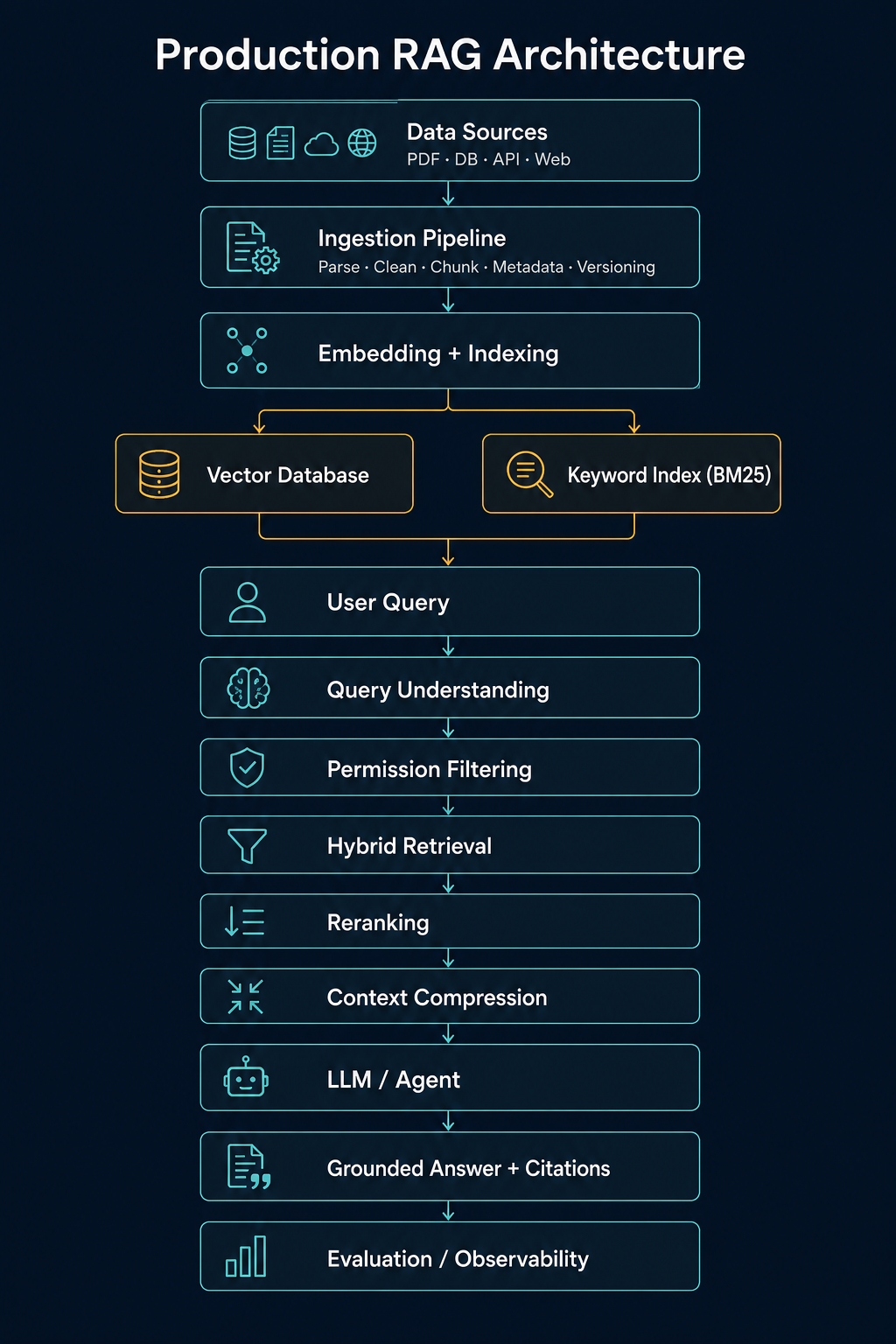
Read it as two halves:
- Offline / ingest — turn trusted sources into searchable, versioned knowledge.
- Online / query — understand the question, retrieve, rerank, compress, generate, cite, and observe.
Everything below walks that map in order.
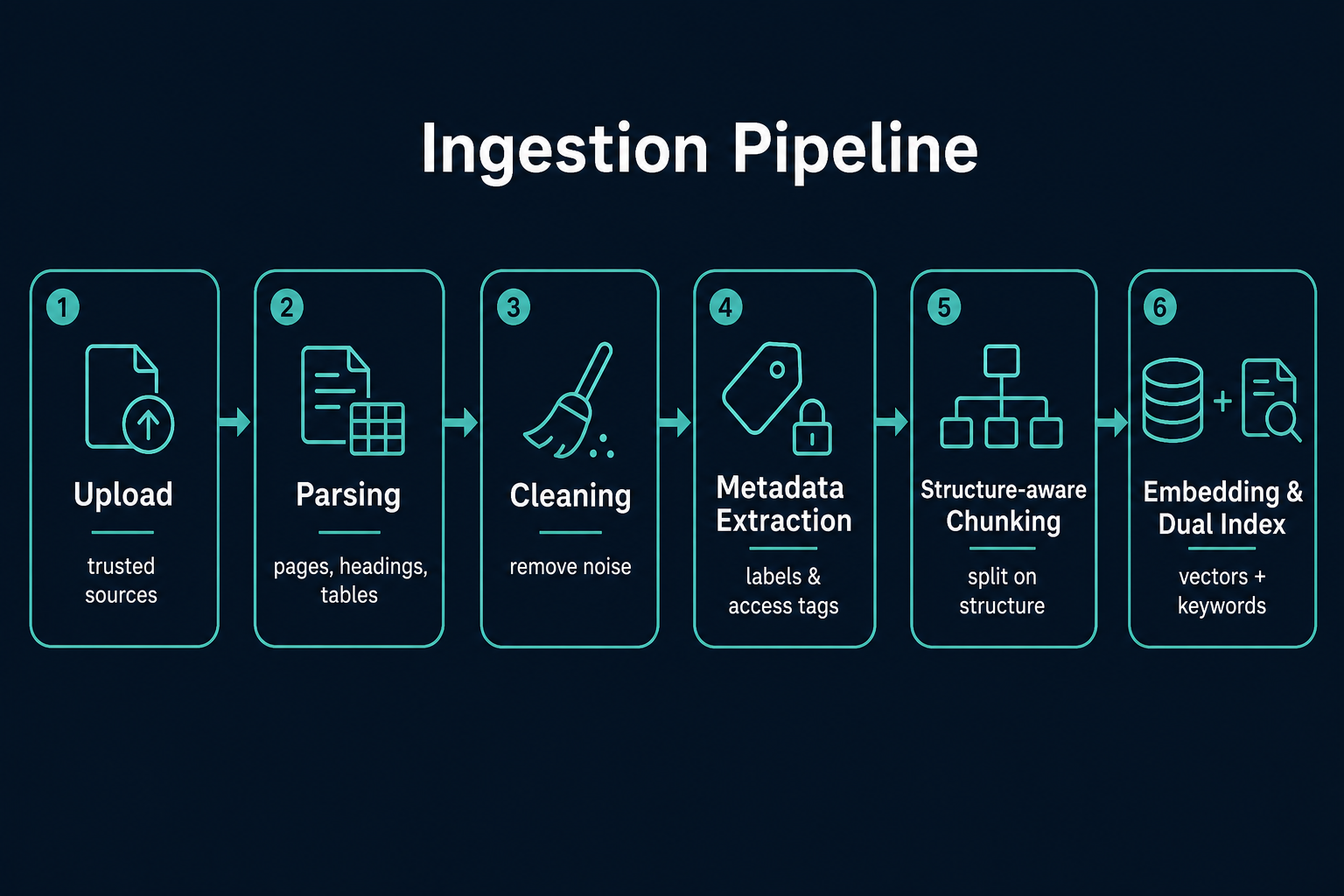
Part 1 — Ingestion: how knowledge enters the system
Data sources
Production systems start with trusted, versioned sources: PDFs, databases, APIs, web pages, internal wikis. Ownership, retention, and PII rules matter as much as file format. If you cannot say which version of a document answered a question, you cannot audit the answer later.
Parsing
Parsing turns raw bytes into structure: pages, headings, tables, lists, images — not one giant string.
Scanned PDFs need OCR that preserves layout cues (markdown headings, page breaks, tables). Structure-aware chunking is impossible if you throw layout away at the door.
How to test it: if whole sections never appear in answers, parse/OCR likely failed on that page or layout.
Cleaning
Cleaning removes retrieval poison: repeated headers and footers, nav junk, near-duplicate lines, “Page N of M” noise.
Over-cleaning deletes useful captions. Under-cleaning leaves boilerplate that embeds as “relevant” and shows up as confident nonsense.
How to test it: repeated footer phrases in answers usually mean cleaning was too weak.
Metadata extraction
Metadata is searchable labels: document type, language, department, version, date, access tags.
At query time, metadata filters shrink the search space (for example, only finance PDFs, or only SOPs a role is allowed to see). This is how production systems prepare for permissions — not with a soft prompt instruction after the fact.
How to test it: wrong labels can hide good chunks when filters are applied.
Structure-aware chunking
Conventional RAG slices every N tokens with a little overlap. Production RAG prefers structure first:
- Split on headings and pages when possible
- Keep tables intact when they are the unit of meaning
- Use overlapping windows only inside long, unstructured sections
Each chunk should carry enough context (section title, source, strategy) to cite later.
How to test it: incomplete answers often mean chunks too small; mixed topics in one citation often mean chunks too large or not structure-aware.
Embedding and dual indexing
Each chunk becomes a meaning vector so paraphrases can match. Embeddings alone miss exact invoice numbers, lot IDs, and rare names — so production stacks usually keep a keyword / BM25-style index beside the vector database.
                 meaning vectors  →  vector DB
chunk text ──►
                 keyword signals  →  BM25 / keyword index
That dual store is what makes hybrid retrieval possible at query time.
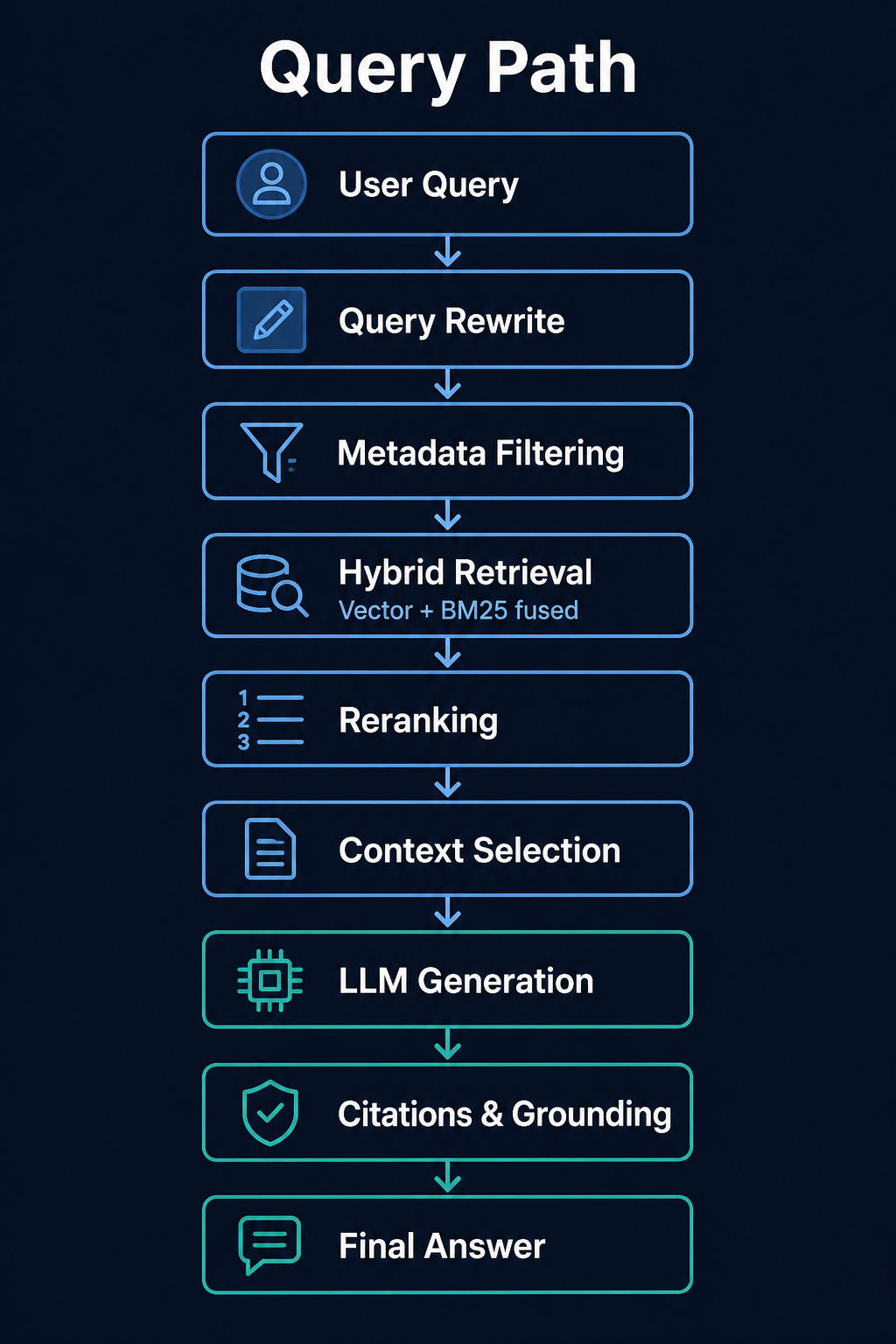
Part 2 — Query time: from question to grounded answer
Query rewrite (query understanding)
Users type chatty questions. Retrievers need searchable intent.
Rewrite expands acronyms, pulls entities, may produce alternate search strings, and can propose filters. The goal is not prettier prose — it is better retrieval.
How to test it: vague questions should become clearer rewritten queries in an audit view.
Metadata and permission filtering
Before ranking, exclude namespaces the user cannot see and optionally narrow by type, source, or version.
If filtering only happens inside the final prompt (“please don’t use confidential docs”), you already retrieved them. Production systems filter before the model writes.
Hybrid retrieval
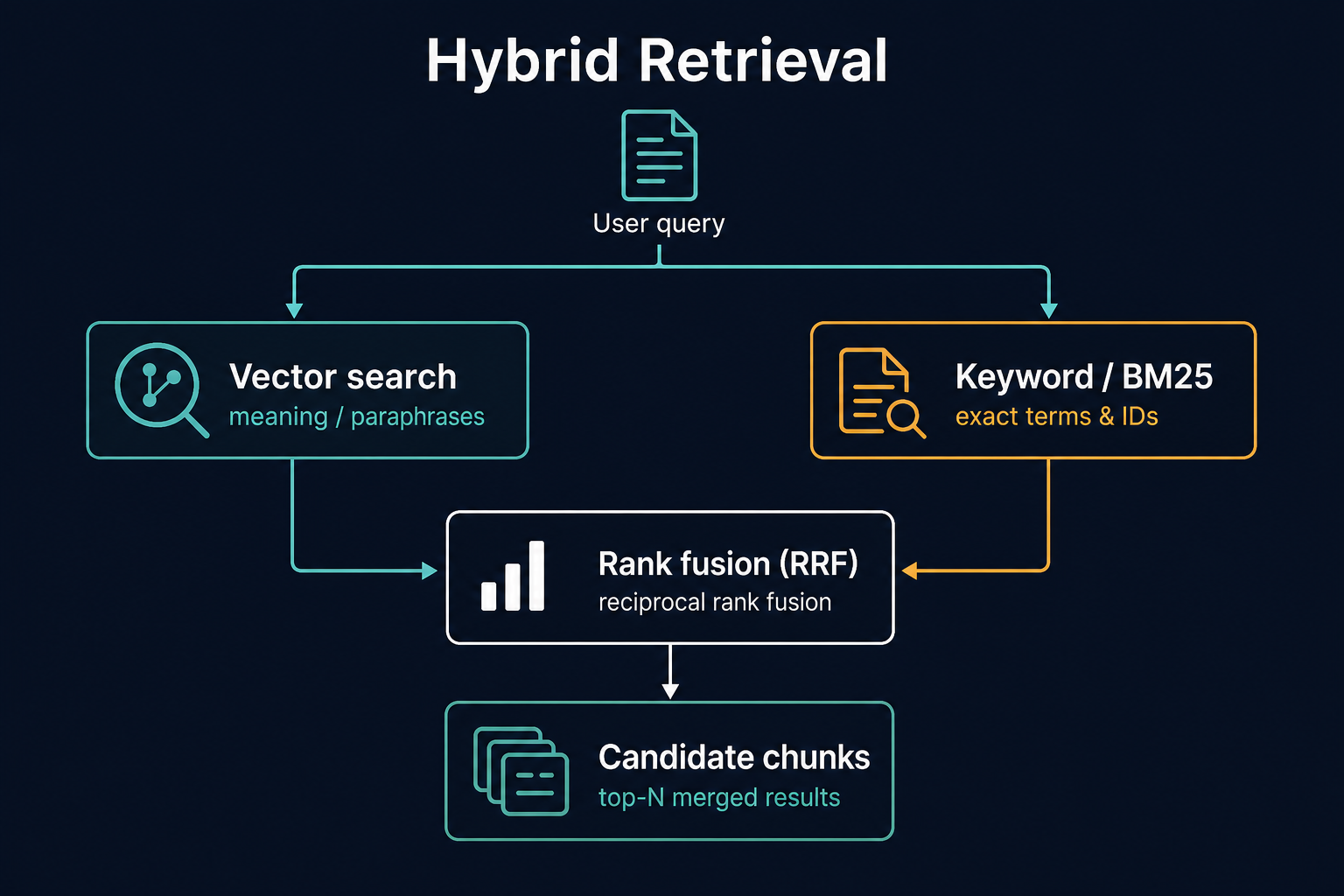
Run vector search and keyword / BM25 search, then fuse ranks (often with Reciprocal Rank Fusion):
- Vectors catch paraphrases (“YoY growth in Germany”)
- Keywords catch rare exact terms
- Fusion keeps both failure modes from dominating alone
This is also where reliability thinking matters more than “add another LLM.” Two identical chat models that share the claim, confidence, and rationale often echo. Different retrieval mechanisms can disagree — and disagreement is what makes a check real.
How to test it: ask with an exact rare term from your document; the keyword path should boost that chunk.
Reranking
Top fused candidates are re-scored for true relevance so weak near-matches drop out. Production often uses a cross-encoder reranker; lighter systems use transparent score blends. The point is the same: don’t pack the context window with polite but useless neighbors.
How to test it: the #1 reranked chunk should actually answer the question.
Context selection and compression
You rarely want every retrieved paragraph. Keep the highest-value spans inside a token budget. Compression reduces cost and hallucination risk while preserving citation anchors.
How to test it: the briefing sent to the model should contain the facts you expect — without huge irrelevant slabs.
LLM generation (grounded)
The model may only use selected context. If evidence is weak, it should say so. Grounded prompts forbid inventing numbers, names, and dates, and require inline citations tied to chunk IDs or sources.
How to test it: ask something not in the docs — a good RAG system refuses.
Citation and grounding
Every important claim should map back to a source span you can open. Grounding checks compare answer claims to evidence. Failed mapping = hallucination risk, even if the prose sounds polished.
How to test it: open citations; if a claim is not in the snippet, that is a grounding failure.
Evaluation and observability
After answers, production systems log latency, retrieval quality, and user feedback. Faithfulness, relevance, and groundedness probes matter more than demo wow. Timing traces tell you whether rewrite, retrieval, or generation is the bottleneck.
A practical starter set of probes:
| Probe | What good looks like |
|---|---|
| In-doc question | Correct answer + matching citations |
| Out-of-doc question | Refusal / “not in documents” |
| Exact rare term | Keyword path helps the right chunk |
| Citation audit | Every important claim appears in a snippet |
| Vague question | Rewrite becomes more specific |
What “safety” actually means here
Adding a second model labeled “validator” can feel like safety while adding only the appearance of safety — especially if it inherits confidence scores, assertive phrasing, and the upstream rationale.
A check is worth something only if it can land somewhere different when the first step is wrong. Hybrid retrieval, hard refusals when context is empty, and citation audits are disagreement paths. Echoes are not.
Stay tuned — Hayat Matrix LIS
Hayat Matrix Lab is a lab information system: patients, tests, results, commissions, reporting, web and desktop. Clinical and lab software is exactly where grounded retrieval matters — SOPs, reference ranges, instrument manuals, and reporting rules cannot be “approximately right.”
We will soon integrate this RAG approach into Hayat Matrix LIS so operators can ask questions against versioned lab knowledge with the same discipline: structured ingest, permission-aware retrieval, hybrid search, and cite-or-refuse answers.
That is the jump from a teaching lab to a domain product: same pipeline principles, stricter metadata, real access control, and evaluation against workflows that affect patient reports.
Coming next
Stay tuned for a follow-up that compares three patterns people often blur together:
- RAG — retrieve evidence, then generate under grounding constraints (this article).
- Agentic AI — tools, loops, and multi-step plans (when search is only one action among many).
- MCP (Model Context Protocol) — how tools and context sources are exposed to models in a standard way.
We will map when to use each, how they compose (an agent that retrieves over shared tools is a common production shape), and what fails when “more agents” is mistaken for “more reliability.”
Closing
Production RAG is not a single embedding call. It is a pipeline with visible stages, dual retrieval channels, hard refusals, and citations you can audit.
If you want to feel that pipeline with your own documents, open the lab, upload something you know, and run the probes above.